

China's UV printing industry is kind of shifting away from being a niche thing and heading more into mainstream industrial territory. Grand View Research put the global UV curable inks market at around USD 1.86 billion in 2023, and their forecast points to pretty solid growth all the way through 2030. You can see that demand in things like signage, packaging, labels, glass, acrylic, and decorative panels. And China? It's become a pretty important manufacturing base for this whole shift. That said, market size estimates do vary depending on the research method used. Hey, if you're a buyer, do yourself a favor and really read through those assumptions carefully. Don't just skim past 'em, okay?
So this guide takes a look at some of the big names in UV inkjet printers—JHF, HandTop, Flora, Docan, and Micolor. They're not all trying to do the same thing, either. Some are built around flatbed printing for rigid sheets, while others lean into roll-to-roll, hybrid setups, or full-on industrial automation. Honestly, you figure out the real differences fast on a busy factory floor. Things like printhead alignment, curing consistency, ink adhesion, and how easy it is for operators to get to the machine? Those matter way more than a shiny brochure. So, Smithers’ research on digital packaging print points to shorter runs, versioned graphics, and quicker changeovers as some of the big things pushing the industry forward. And yeah, those same pressures? They’re starting to shape how Chinese equipment gets designed.
But reliability? Well, that still needs proof.
So, if you're trying to judge whether a printer is really worth it, don't just look at the spec sheet. Compare actual print samples, nozzle compensation, RIP compatibility, warranty terms, and how quickly local service responds. And yes—ask for tests on your own substrates. Acrylic might come out with nice clean edges, but a textured board? That's where banding can show up. It's also worth thinking about energy use and ventilation in the workspace. Independent certifications, a documented maintenance schedule, and clear ink specs all help a supplier feel more credible. That said, no manufacturer gets everything perfect. Honestly, those published performance numbers? They can be based on ideal conditions—not what you'll actually see day to day on the production floor. That's why it pays to ask the right questions. At the end of the day, the right pick really comes down to your workload, the substrate range you need, your budget, and the technical support behind it—not just how well-known the brand is.

What Are UV Inkjet Printers?
Top UV Inkjet Printer Manufacturers in China
UV inkjet printers deposit liquid ink onto a surface, then cure it instantly with ultraviolet LED light. This process creates sharp images without extended drying time. Unlike traditional printers, they can print directly on acrylic, glass, metal, wood, ceramic, and coated plastics.
Most systems use piezoelectric printheads, which release controlled ink droplets at high speed. Flatbed models handle rigid sheets, while roll-to-roll machines support flexible materials. White ink and varnish channels can add raised textures, highlights, or stronger contrast. These features explain their use in signage, packaging, interior decoration, and customized products.
Market data supports this growth. Grand View Research estimated the global UV curable ink market at about USD 1.85 billion in 2023, with continued expansion expected through 2030. Smithers also identifies digital printing as a growing force in packaging and specialty production. However, the technology is not effortless. Ink adhesion depends on surface energy, cleaning, lamp intensity, and curing distance. Poor calibration may cause banding, uneven gloss, or weak bonding. That part is sometimes underestimated.
For buyers comparing Chinese manufacturers, practical evaluation matters more than a specification sheet. Request sample tests using your actual substrate, image files, and production speed. Check nozzle stability, white-ink circulation, software control, spare-part availability, and operator training. A lower purchase price can become expensive when maintenance is difficult. Claims still need verification.
Top UV Inkjet Printer Manufacturers in China - What Are UV Inkjet Printers?
| Data Dimension | Typical Technical Data | What It Means |
|---|---|---|
| Printing Technology | Drop-on-demand inkjet | The printhead ejects controlled droplets only when required, enabling precise digital image reproduction without printing plates. |
| Ink Curing Method | Ultraviolet light curing, usually LED-based | UV-sensitive ink is rapidly hardened after deposition, allowing printed surfaces to be handled soon after printing. |
| Common UV Wavelength | Approximately 365–405 nm; 395–405 nm is widely used | The required wavelength depends on the photoinitiator system used in the ink and the curing-unit design. |
| Supported Substrates | Plastic, acrylic, glass, metal, wood, ceramic, leather, paper and coated materials | UV printing can work on many rigid and flexible materials, subject to surface energy, adhesion and printer configuration. |
| Typical Ink Colors | CMYK; optional light cyan, light magenta, white, clear and varnish | White ink supports printing on dark or transparent substrates, while clear ink can create gloss, texture and spot-finishing effects. |
| Typical Resolution Range | Approximately 600–1,440 dpi, depending on print mode | Higher resolution can improve fine detail, but production speed, ink configuration and substrate quality also affect the final result. |
| Ink Droplet Size | Commonly about 3–50 picoliters, depending on printhead and mode | Smaller droplets help reproduce fine details, while larger droplets can increase coverage and productivity. |
| Print Surface Type | Flatbed, roll-to-roll or hybrid | Flatbed systems are suited to rigid sheets; roll-to-roll systems handle flexible media; hybrid systems support both formats. |
| Common Applications | Signage, packaging prototypes, décor, labels, promotional products and industrial marking | The technology is useful for short runs, variable data, customized products and direct-to-object printing. |
| Material Thickness | From thin flexible media to thick rigid boards; exact capacity is model-specific | The maximum thickness depends on the carriage height, vacuum table, media-handling system and available clearance. |
| Drying and Finishing | Immediate or near-immediate surface curing | Unlike water-based systems, UV ink does not primarily rely on evaporation, although full adhesion and chemical resistance depend on curing conditions. |
| Key Selection Criteria | Print width, media thickness, ink set, curing power, resolution, throughput and maintenance design | These factors should be matched to the intended substrate, production volume, image quality requirements and operating environment. |
| Main Advantages | Broad material compatibility, fast curing, low setup requirements and customized production | UV inkjet printing supports direct digital workflows and can reduce setup time for short-run and variable-content work. |
Note: Technical ranges are general industry references. Actual performance varies by printer configuration, printhead, UV ink formulation, substrate and production mode.
Standard Rewinder with UV Inkjet Printer: Efficient, High-Quality Label Production Solutions
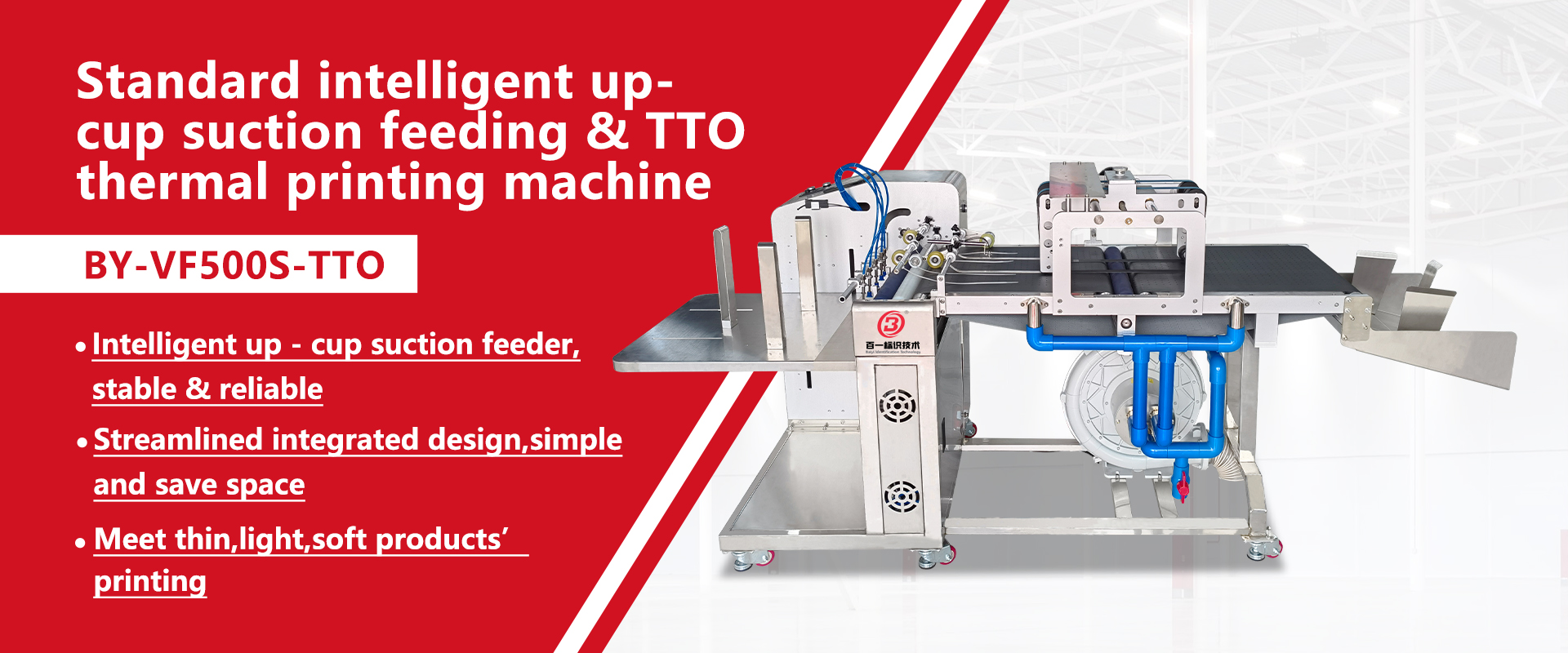
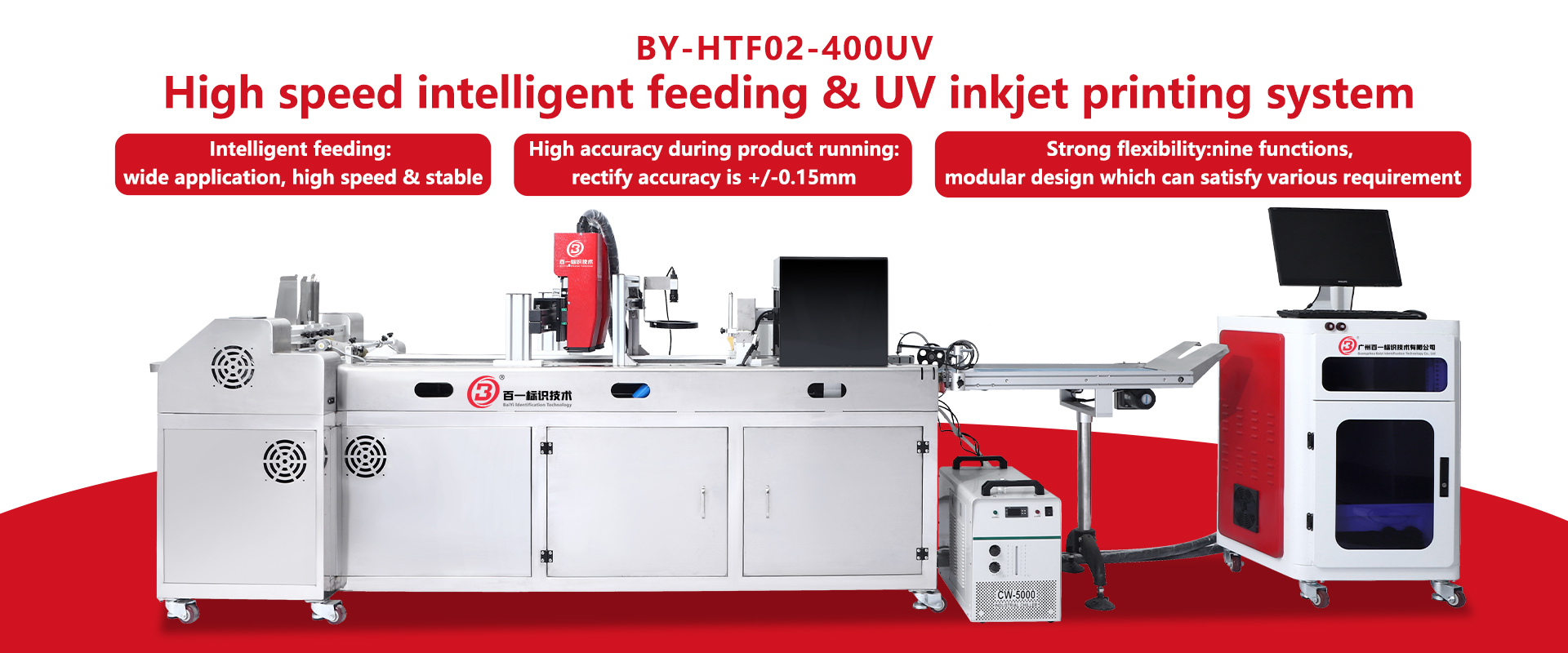
The Standard Rewinder with UV Inkjet Printer is designed for efficient, high-quality label and packaging film production. It supports both roll-to-roll film processing and label rewinding, making it suitable for businesses handling different material structures and production requirements. The system can be configured for UV printing or thermal transfer overprinting, allowing users to select the functions and modules that best match their workflow. This flexible design helps streamline coding and printing tasks while maintaining consistent output quality.
Available in models BY-SR500-TTO, BY-SR500-UV, and BY-HR450-UV, the machine features a 7-inch color HMI, PLC control, and an integrated microcomputer for intelligent operation. Operators can set parameters according to the characteristics of paper labels or packaging films, while the interface provides real-time status monitoring and alarm notifications. Linear material release and collection, adjustable lifting speed, anti-loosening control during stops, and white-mark or color-patch sensing help improve production stability. An optional automatic web-guiding system is also available for applications requiring enhanced printing alignment and accuracy.

FAQS
A piezoelectric printhead releases tiny droplets at controlled times and positions. Each droplet forms part of the image.
UV LEDs activate photoinitiators inside the ink. The ink hardens almost immediately. It is not magic.
They can print on acrylic, glass, metal, wood, ceramic, and coated materials. Results vary by surface condition.
No. Clean surfaces, static control, and suitable pretreatment remain important. A beautiful print may still scratch or peel.
Test charts reveal dot placement, curing strength, gloss, and color consistency. They help identify problems before a full production run.
White pigment can settle inside the ink system. Circulation helps maintain stable density and coverage. Neglecting it can create uneven results.
Excessive distance can soften edges and reduce fine detail. Small text may look less sharp. Height needs practical adjustment.
Temperature and humidity can alter ink behavior. A clean nozzle may still produce uneven tones during long operation. Records help, though records are not enough.
Request samples using your actual material, such as textured boards or coated film. Check small text, solid colors, white coverage, and curing consistency.
Not always. Lower prices may hide weaker components, limited testing, or slow technical service. Repeat testing is worth the extra time.
Conclusion
UV inkjet printers are advanced digital printing systems that use ultraviolet light to cure specially formulated ink immediately after it is applied. This process enables sharp, durable images on a wide range of materials, including plastic, glass, metal, wood, acrylic, and coated surfaces. The article explains how UV curing works, why this technology supports fast production and high-quality customization, and why Chinese Uv Inkjet Printer Manufacturers are increasingly considered by international buyers for their broad product selection, technical development, flexible configurations, and competitive pricing.
It also introduces the main types of suppliers available in China and provides practical guidance for comparing them. Buyers should evaluate print quality, curing performance, machine stability, maintenance requirements, software compatibility, production capacity, customization options, warranty terms, training, and after-sales support. Before making a purchase, it is important to match the printer’s specifications with the intended materials, workload, budget, workspace, and long-term operating costs. A careful assessment can help businesses choose a reliable solution that delivers consistent results and supports future growth.
Related Posts
-

What Is a UV Inkjet Printer Manufacturer?
-

Top 10 Uv Inkjet Printer Manufacturers in China for Global Buyers?
-

How to Choose a UV Inkjet Manufacturer in 2026
-

2026 How to Choose the Best Cij Inkjet Printer Manufacturers?
-

How to Choose the Right Cij Printer Manufacturer for Your Needs?
-

What is a High Speed Printing Feeder Manufacturer?


